


On May 28, 2026, federal agencies issued a new Federal Independent Dispute Resolution (IDR) Operations Final Rule under the No Surprises Act. For health plans, employers, TPAs, hospitals, and physician groups, the rule is less about changing the core law and more about tightening the day-to-day mechanics of how payment disputes move through the federal IDR process.
A Quick Refresher: What the IDR Process Does
The federal IDR process serves as the "baseball-style" tie-breaker when a health plan or issuer and an out-of-network provider, facility, or air ambulance provider cannot agree on payment for certain items or services covered under the No Surprises Act.
The process generally follows four steps:
- A claim is paid or denied.
- The parties attempt to resolve the payment dispute through an open negotiation period.
- If they cannot reach an agreement, either party may initiate the federal IDR process.
- A certified IDR entity reviews the parties’ offers and chooses one.
For benefits and revenue cycle teams, the key takeaway is that IDR is intended to be a structured payment resolution process after negotiations have failed, not the starting point for resolving payment disputes.
What’s Changing?
The final rule focuses on operations and process discipline.
More Complete Payment Disclosures
Plans and issuers must provide more detailed information when issuing an initial payment or denial, including:
- Claim-specific information
- The Qualifying Payment Amount (QPA)
- Contact information for beginning open negotiation
Providing this information should make it easier for providers to understand the basis for payment and reduce avoidable process disputes.
Updated Open Negotiation Requirements
The rule also updates contact information requirements during the open negotiation process.
Plans and issuers should verify that payment and denial communications include the correct contact information and are routed to the teams responsible for handling negotiations. Likewise, providers should use the designated contacts and carefully document their negotiation efforts.
Clearer Rules for Batching Claims
The rule provides additional guidance on batching and bundling claims.
Because disputes are often delayed or rejected when claims are grouped incorrectly, the new guidance is aimed at improving consistency in how related items and services may be submitted together.
Earlier Eligibility Reviews
The final rule formalizes portions of the eligibility review and withdrawal process.
That should help resolve threshold questions earlier in the process and provide clearer pathways for withdrawing disputes when appropriate, rather than letting filings linger.
Lower Administrative Fee
One of the most notable changes is the administrative fee.
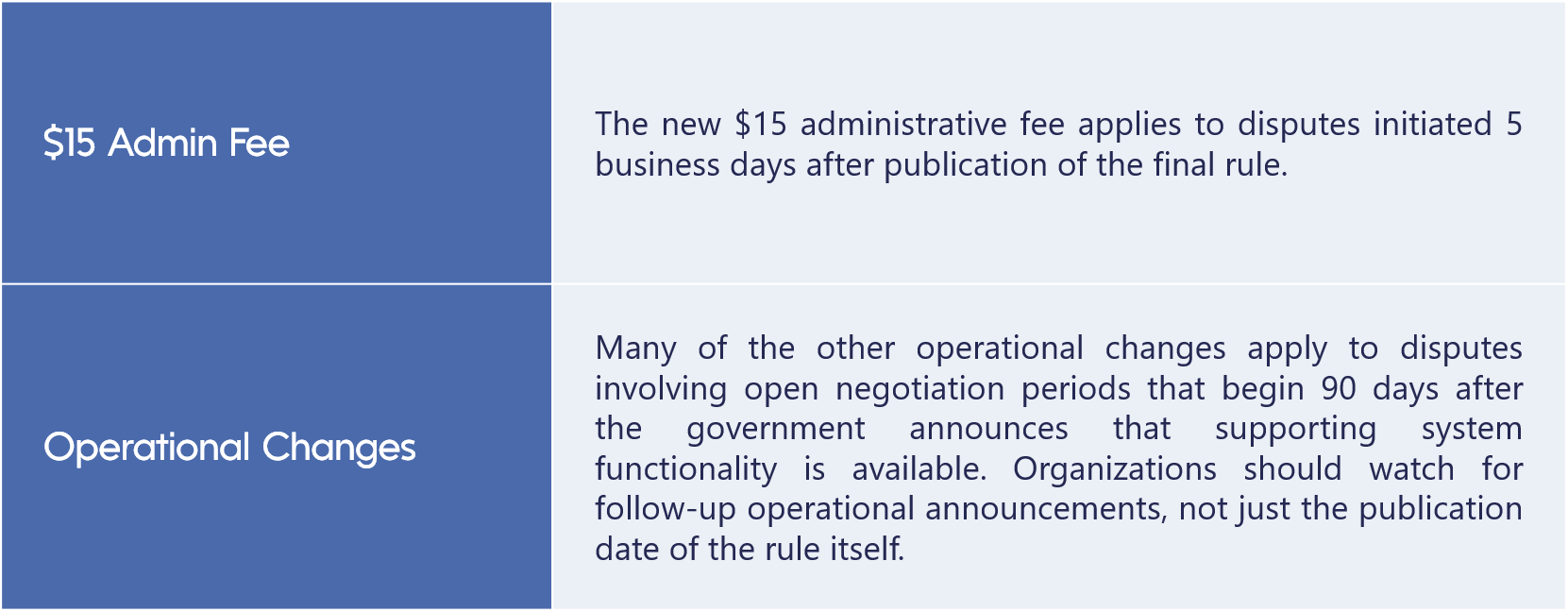
The fee decreases from $115 per party per dispute to $15 per party per dispute, which may make the federal IDR process more accessible in closer-dollar disputes.
When Do These Changes Take Effect?
The timing is important as not every provision becomes effective at the same time.
Registration Is Now Required
One of the most important operational changes is that registration is now a prerequisite for participating in the federal IDR process.
Payers subject to the federal IDR process must register with the Departments and obtain an IDR registration number before participating. Registration should be viewed as a required first step, not something to complete after a payment dispute arises.
After registration, plans and issuers receive an IDR registration number that is used in required disclosures and within the Federal IDR portal to identify the appropriate coverage during the dispute process.
What Group Health Plans and TPAs Should Do Now
Group health plans, TPAs, and other delegated entities should prepare before the first dispute arrives by confirming that:
- Registration has been completed.
- The IDR registration number is documented and readily available.
- Appropriate staff have Federal IDR portal access.
- Contact information is accurate and up to date.
- Internal teams understand who is responsible for open negotiations and IDR filings.
Addressing these items in advance can help organizations avoid missed deadlines during the tight timeframes that govern the IDR process.
Certified IDR entities must also remain certified by the Departments and comply with ongoing operational and reporting requirements.
Bottom Line
This final rule is a process-focused update, but it has real operational consequences. Plans and providers that tighten their notices, contacts, documentation, and dispute intake practices now will be better positioned to avoid preventable friction once the new IDR requirements take hold.